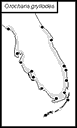
20 s of calling song; male from Levy Co., Fla.: Cedar Key; 26.5°C. (WTL682-4a)
Click on sound bar to hear graphed song.
Sound spectrogram of 2 s of calling at 26.5°C from WTL682-4a). Dominant frequency is 5.7 kHz.
Click on spectrogram to see an expansion of the last two chirps.
Song at 25°C:
Buzzy chirps usually produced in groups of 2 or 3 with groups at intervals of 2–3 sec. Chirps have 10–14 pulses at 216 p/s, one of the fastest wingstroke rates known for crickets.
Identification:
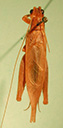
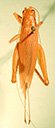
Length 17-22 mm. Ocellar diameter greater than distance between lateral and medial ocellus; no conical projections at ocelli; some bristles longer than 0.1 mm on head behind ocelli. Stridulatory file has 23–31 teeth.
Similar species:
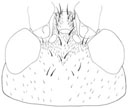
A. oriobates is easily distinguished from the North American species of Orocharis by the large ocelli with little space between (see drawing of head), the only other U.S. species of Antillicharis is known from a single male from Biscayne Bay, Florida, and was recognized as distinct from A. gryllodes based on features of its genitalia.
Habitat:
Mangroves and subtropical hammocks.
Season:
Year-round.
Remarks:
This species was long known as Orocharis gryllodes, but that species may occur only in Jamaica. The Florida populations once known by that name now have the scientific name Antillicharis oriobates (see references below). The genus Antillicharis occurs throughout the West Indies and it would not be surprising if A. oriobates was abundant in Cuba.