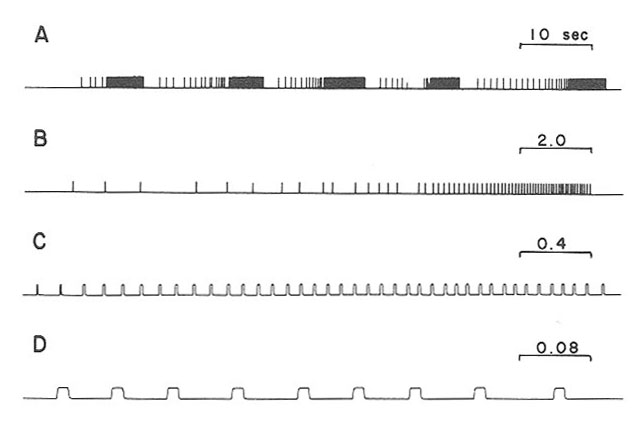
Event recorder displays of the timing of pulses in the calling song at 24.4°C (from WTL672-4a).
Each vertical mark or open rectangle represents one pulse. A) 75 s of calling.
B) The 2nd sequence in A. C) The terminal 40 pulses of the 2nd sequence. D) The terminal 9 pulses of the 2nd sequence. (Fig. 4,
Walker 1977.)
|
Song at 25°C:
|
A musical, irregular tink, tink, tink that speeds up and becomes a trill of ca. 14 p/s. Each such sequence lasts 8-20 sec., with the carrier frequency gradually increasing by several hundred Hertz. Courtship singing resembles calling except that the tinks are more irregular and no trills are produced.
|
|
Identification:
|
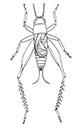
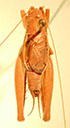
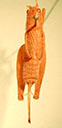
Length 15–19 mm. Forewings covering less than two-thirds of abdomen; length of forewings generally more than 2.3 (males) or 2.2 (females) times medial length of pronotum. Stridulatory file with more than 70 teeth, 1.5 to 1.8 mm long.
|
|
Similar species:
|
Short-winged bush cricket—wings shorter; fewer than 70 teeth in stridulatory file; no calling song.
|
|
Habitat:
|
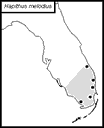
On grass and shrubby undergrowth, especially in pinewoods and in sawgrass marshes.
|
|
Season:
|
June–Oct.
|
|
Remarks:
|
This and the preceding species are closely related. They have not been found together, but specimens of the two collected 50 miles apart maintain their distinctive features.
|
|
More information:
|
Subfamily Eneopterinae, genus Hapithus.
|
|
References:
|
Walker 1977.
|
|
Nomenclature:
|
OSF (Orthoptera Species File Online).
|