common name: a stored products pest
scientific name: Oryzaephilus acuminatus Halstead (Insecta: Coleoptera: Silvanidae)
Introduction - Distribution - Description - Biology - Identification Key - Hosts - Management - Selected References
Introduction (Back to Top)
A commercial nursery in Fort Myers, Florida imported seeds of the neem tree (Azadirachta indica A. Juas) from India to be used for their purported insecticidal properties. Beetles were discovered in the storage area on 11 January 1983 and were sent to the Florida Department of Agriculture for identification. They were identified by the senior author as Oryzaephilus acuminatus Halstead, constituting the first United States record. Recommendations were immediately made to fumigate the area where the seed was stored in order to prevent establishment of the pest.
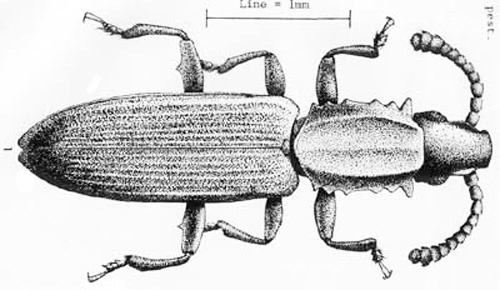
Figure 1. Adult male Oryzaephilus acuminatus Halstead, a stored products pest. Graphic by Division of Plant Industry.
A previous shipment of 1,000 kilos of the seed was made a year earlier, but no beetles were noted then. The present shipment, consisting of 3,000 kilos, left India in September 1982, arriving in Los Angeles (San Pedro) on 12 December 1982. It was then shipped to Miami and stored for about three weeks before being shipped to Fort Myers. There it was stored in a room with part of the previous shipment. Thousands of beetles (all stages) were found in the storage area. This area was fumigated and the surrounding nursery and greenhouse areas were treated. All subsequent inspections were negative (after nine months).
Distribution (Back to Top)
Halstead (1980) recorded it from India, Sri Lanka, and England (imported on coconut shells). The discovery of this species in Fort Myers represents the first record of its occurrence outside the Old World (Halstead, personal communication).
Description (Back to Top)
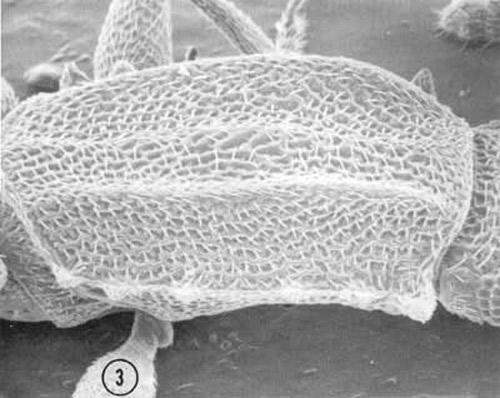
Oryzaephilus acuminatus is similar to the other two stored products species of Oryzaephilus found in the U.S. Adults are dark brown to black with recumbent golden setae. Males range in length from 3.4 to 3.7 mm; females from 3.3 to 3.5 mm. Body elongate, parallel sided, ratio of length to width 4.3 to 4.4:1 in males, 3.9 to 4.1:1 in females. Pronotum in large males elongate, 1.5 to 1.7:1; lateral ridges and anterior pronotal angles strongly developed (all above ratios are from Halstead, 1980). The immature stages have not been described, but larvae resemble those of the saw- toothed grain beetle [Oryzaephilus surinamensis (L.)] illustrated by Peterson (1979: fig. C49-A).
Figure 2. Oblique view of the pronotum of an adult male Oryzaephilus acuminatus Halstead, a stored products pest, showing the strongly developed anterior pronotal angles. Photograph by Division of Plant Industry.
In Cutler's (1971) key to the larvae of some economically important silvanids, Oryzaephilus acuminatus would key to Oryzaephilus mercator, the merchant grain beetle, sharing with that species the possession of four long, antero-lateral setae on abdominal tergites 2 to 7.
Biology (Back to Top)
In the original description, Halstead (1980) reported on crossing experiments among Oryzaephilus acuminatus, Oryzaephilus mercator, and Oryzaephilus surinamensis; Oryzaephilus acuminatus and Oryzaephilus mercator resulted in a few sterile hybrids; Oryzaephilus acuminatus and Oryzaephilus surinamensis were entirely unsuccessful. He noted in Oryzaephilus acuminatus that: "Its performance in cultures at constant temperatures suggests considerable pest potential." Some paratypes were designated from a culture of specimens collected in England in coconut shells imported from India.
After studying Oryzaephilus acuminatus at a variety of temperatures, humidities, and culture media, Jacob (1981) concluded that "... there are good reasons for concluding that Oryzaephilus acuminatus will not succeed as a storage pest as well as the other two species. Oryzaephilus acuminatus lays fewer eggs and this alone would probably lead to its failure in competition with them. Although it develops on cereals as quickly as Oryzaephilus mercator, its low rate of oviposition and considerable mortality of developing larvae and pupae ensure that its potential for increase is less."
Identification Key (Back to Top)
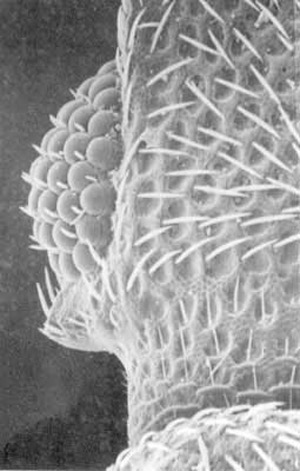
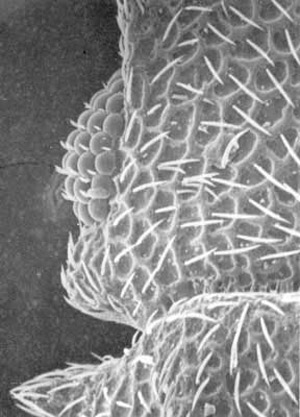
Although Oryzaephilus acuminatus is superficially similar to both the saw-toothed grain beetle (Oryzaephilus surinamensis) and the merchant grain beetle (Oryzaephilus mercator) there are numerous structural differences distinguishing adults of the three species. Both Oryzaephilus mercator and Oryzaephilus acuminatus have relatively large eyes and short temples, while Oryzaephilus surinamensis has small eyes and long temples. Identification of Oryzaephilus acuminatus was confirmed by comparison with a paratype in the Florida State Collection of Arthropods. The following key, modified from Halstead (1980), should permit the identification of both sexes of these three species.
1. Temple at least one-half length of eye, not sharply angulate behind (Fig. 6) . . . . . Oryzaephilus surinamensis (L.), sawtoothed grain beetle
1'. Temple less than one-third length of eye, sharply angulate behind (Fig. 5). . . . . 2
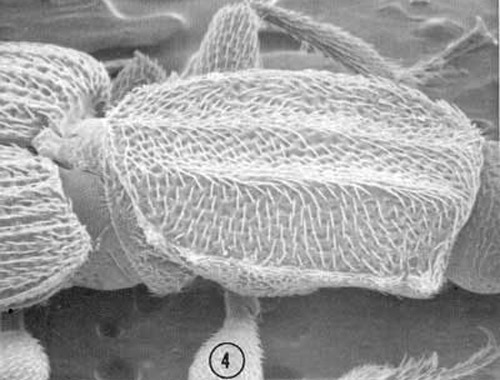
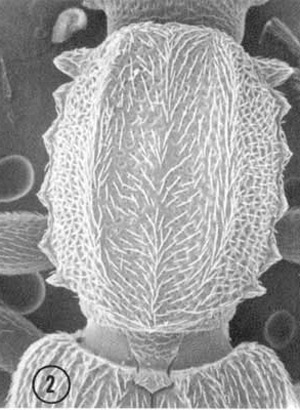
2 . Anterior pronotal angle moderately developed in large males; body less elongate (3.6-4.1:1); pronotum of large males with lateral ridges not strongly elevated (Figs. 2 and 4). . . . . Oryzaephilus mercator (Fauvel), merchant grain beetle
2'. Anterior pronotal angles strongly developed in large males; body more elongate (3.9-4.4:1); pronotum of large males with lateral ridges strongly produced (Fig. 3) . . . . . Oryzaephilus acuminatus Halstead, no common name
Figure 3. Dorsal view of the pronotum of an adult male Oryzaephilus mercator (Fauvel), the merchant grain beetle, showing lesser development of anterior pronotal angles, compared to Oryzaephilus acuminatus Halstead. Photograph by Division of Plant Industry.
Figure 4. Oblique view of the pronotum of an adult male Oryzaephilus mercator (Fauvel), the merchant grain beetle, showing lesser development of anterior pronotal angles, compared to Oryzaephilus acuminatus Halstead. Photograph by Division of Plant Industry.
Figure 5. Dorsal view of the left eye and temple of an adult Oryzaephilus mercator (Fauvel). Photograph by Division of Plant Industry.
Figure 6. Dorsal view of the left eye and temple of an adult Oryzaephilus surinamensis (L.). Photograph by Division of Plant Industry.
Male genitalia are also diagnostic for each species (see Halstead 1980).
Hosts (Back to Top)
The neem tree (Azadirachta indica A. Juas) is primarily Indian in distribution. At least one tree is growing at the USDA Plant Introduction Station in southern Miami. The beetle appears to thrive in dry stored materials; in this case seeds. Although these seeds are reported to have insecticidal properties, the chemical does not appear to be toxic to Oryzaephilus acuminatus.
Although some host preferences may exist, it is likely that any stored plant materials could provide sustenance. The British interceptions were in coconut shells, and it was cultured on groundnuts, on copra, and on a mixture of rolled oats, wheatfeed, and yeast in the laboratory. The saw-toothed grain beetle is found in flour, grains, seeds, and many kinds of stored products.
Management (Back to Top)
For management information see ENY-213 Pantry and Stored Food Pests (https://edis.ifas.ufl.edu/ig095).
Selected References (Back to Top)
- Cutler JR. 1971. A key for distinguishing the larvae of Ahasverus advena (Waltl), Cathartus quadricollis (Guer.), Oryzaephilus surinamensis (L.) and Oryzaephilus mercator (Fauv.) (Coleoptera; Silvanidae). Journal of Stored Product Research 7: 125-127.
- Halstead DGH. 1980. A revision of the genus Oryzaephilus Ganglbauer, including descriptions of related genera. (Coleoptera: Silvanidae). Zoological Journal of the Linnean Society 69: 271-374.
- Jacob TA. 1981. Observations of the biology of Oryzaephilus acuminatus Halstead with comparative notes on the common species of Oryzaephilus (Coleoptera: Silvanidae). Journal of Stored Product Research 17: 17-23.
- Peterson A. 1979. Larvae of Insects: An Introduction to the Nearctic species. Part II. Coleoptera, Diptera, Neuroptera, Siphonaptera, Mecoptera, Trichoptera. Columbus. (Published by the author). 416 p.