common name: greenhouse thrips
scientific name: Heliothrips haemorrhoidalis (Bouché) (Insecta: Thysanoptera: Thripidae)
Introduction - Synonymy - Distribution - Description and Biology - Hosts - Economic Importance - Management - Selected References
Introduction (Back to Top)
This thrips was described by Bouché in 1833 from specimens taken from a greenhouse in Europe. Packard described this species for the first time from the United States in 1870 and renamed it the greenhouse thrips, Heliothrips haemorrhoidalis (Bouché).
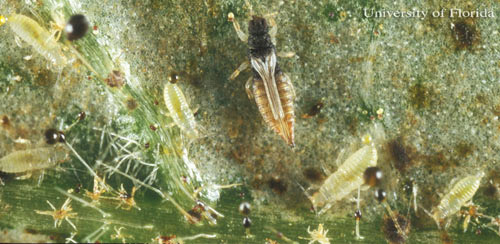
Figure 1. Adult and immature greenhouse thrips, Heliothrips haemorrhoidalis (Bouché). Photograph by Lyle J. Buss, University of Florida.
Synonymy (Back to Top)
Thrips haemorrhoidalis Bouché 1833
Heliothrips adonidum Haliday, 1836
Thrips haemorrhoidalis var. abdominalis Reuter, 1891
Thrips haemorrhoidalis var. ceylonica Schmutz, 1913
Thrips haemorrhoidalis var. angustior Priesner, 1923
Heliothrips semiaureus Girault, 1928
Dinurothrips rufiventris Girault, 1929
(CSIRO 2009)
Distribution (Back to Top)
This species occurs worldwide in the tropics and sub-tropics. Although originally described from Europe, it originated in South America (CSIRO 2009). It was probably introduced into Europe on ornamental plants from tropical America. This thrips can probably be found over much of the world due to its habit of living in greenhouses. Greenhouse thrips are found on wild and cultivated plants.
In the United States, it is found outdoors in central and southern Florida and southern California. It is found in greenhouses throughout the United States. Sometimes it escapes from greenhouses in warm months in states north of Florida.
Description and Biology (Back to Top)
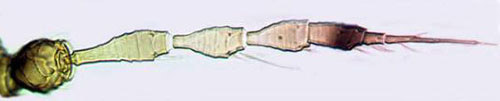
As it matures into an adult, head and thorax of the the greenhouse thrips darken to black and the abdomen changes from yellowto dark brown. Cool temperatures retard the color changes. The legs remain a light yellow and the antenna has eight segments. The greenhouse thrips is parthenogenic, in that it reproduces without mating, and males are seldom seen. It is a poor flier and tends to remain in the shaded areas on the plant.
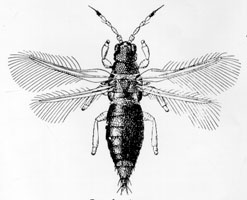
Figure 2. Adult thrips, showing fringed wings. Graphic by Division of Plant Industry.
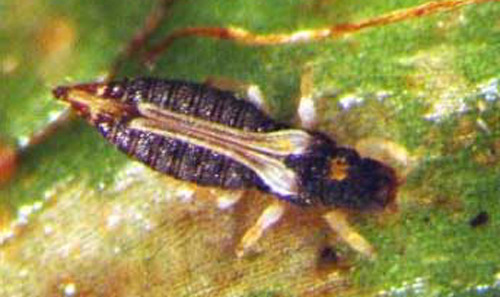
Figure 3. Adult greenhouse thrips, Heliothrips haemorrhoidalis (Bouché). Photograph by Mike Merchant, Texas Cooperative Extension Service.
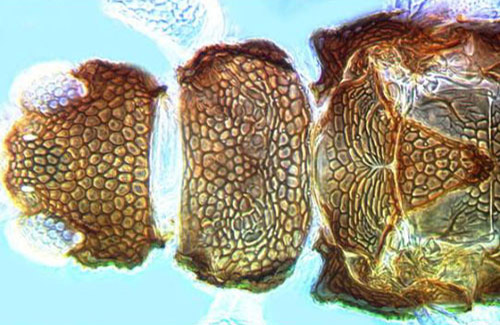
Figure 4. Head and thorax of an adult greenhouse thrips, Heliothrips haemorrhoidalis (Bouché). Photograph by Laurence Mound ANIC, CSIRO; Illustration courtesy of http://www.padil.gov.au/ Used with permission.
Figure 5. Antenna of an adult greenhouse thrips, Heliothrips haemorrhoidalis (Bouché). Photograph by Laurence Mound ANIC, CSIRO; Illustration courtesy of http://www.padil.gov.au/ Used with permission.
The adult females insert their eggs into the leaf or fruit surface. Just before hatching the egg blisters. A hand lens helps somewhat in surveying for emerging populations as it shows where the eggs are in the leaves, only the tip being visible. The eggs are white and banana-shaped and are inserted singly in plant tissue.
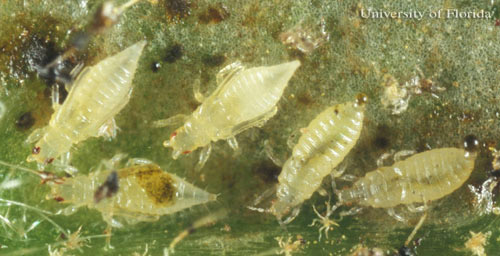
The early larval stage is whitish with red eyes. Larvae become yellowish after feeding. Mature larvae average 1 mm in length. Greenhouse thrips undergo two larval instarsthen molt to the prepupal stage which is light yellow with red eyes and short wing pads. The pupal stage is slightly larger, with longer wing pads and larger eyes. It is yellowish and then darkens with age. The antennae are bent backward over the head in the pupal stage. The prepupal and pupal stages do not feed.
Figure 6. Larvae and pupae of the greenhouse thrips, Heliothrips haemorrhoidalis (Bouché). Photograph by Lyle J. Buss, University of Florida.
Hosts (Back to Top)
In Florida, this thrips is found especially on crotons, but has been taken from ardisia, Aspidium sp., avocado, azalea, Coleus sp., Crinum sp., dahlias, dogwood, ferns, Ficus nitida, guavas, hibiscus, natal plum, magnolia, mangoes, maple, orchids, palms, philodendron, phlox, pinks, viburnum, Vitis sp., and many other ornamentals.
The greenhouse thrips causes rind blemish problems on developing citrus fruit (i.e., ring spotting or irregular russeting), on immature and mature clustered fruit, or where a leaf or twig is in direct contact with fruit (Stansly et al. 2003).
Economic Importance (Back to Top)
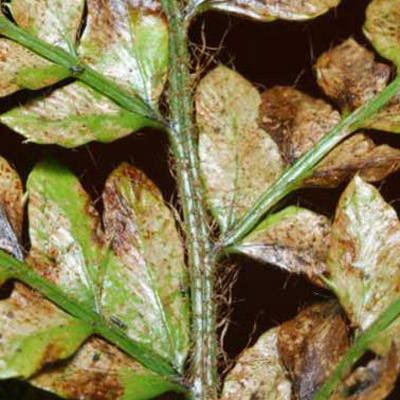
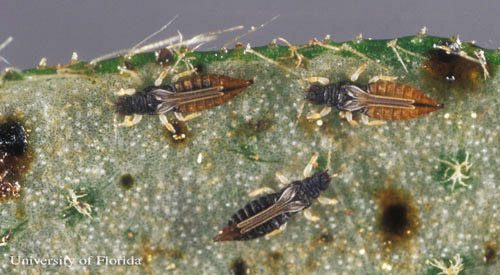
This thrips feeds primarily on the foliage of ornamental plants. It attacks the lower surface first and, as feeding progresses and the population increases, moves to the upper surface. The leaves become discolored and become distorted between the lateral veins. Severely damaged leaves turn yellow and drop. In addition to the feeding damage, both surfaces are covered with small droplets of a reddish fluid, voided by the thrips, that gradually turn black. These globules of fluid increase in size until they fall off, resulting in a characteristic spotting of the infested area with black specks of fecal material. The globules serve as deterrents to predators.
Figure 7. Damage produced by greenhouse thrips, Heliothrips haemorrhoidalis (Bouché), feeding on wood fern. Photograph by Mike Merchant, Texas Cooperative Extension Service.
Figure 8. Adult greenhouse thrips, Heliothrips haemorrhoidalis (Bouché), with feeding damage and fecal specks. Photograph by Lyle J. Buss, University of Florida.
The greenhouse thrips injures the leaves and fruit of citrus, but does not cause leaf drop. The damage of the fruit may be well defined depressed areas, often with irregular reticulation. This kind of damage occurs when fruit is immature. On mature fruit this damage is not well defined and merges into the healthy peel without a depression.
The greenhouse thrips also damages avocados and is an important pest of that fruit in New Zealand and other areas (Stevens et al. 1999).
Management (Back to Top)
Only one effective natural enemy is known to attack greenhouse thrips. The minute larval parasite Thripobius semiluteus, which was introduced into California from Brazil and Australia in the mid-1980s. Parasitized thrips larvae appear swollen and the sides of their body are more parallel than tapered as in healthy thrips larvae. The immobile parasite pupae appear black among the colonies of translucent, unparasitized thrips.
Other less effective natural enemies include an egg parasite, Megaphragma mymaripenne, and three predatory thrips species, Franklinothrips orizabensis, Franklinothrips vespiformis, and Leptothrips mali, also known as the black hunter.
Current Florida management recommendations may be found at:
Florida Citrus Pest Management Guide for thrips
Selected References (Back to Top)
- Bethke JA. (June 2010). Floriculture and Ornamental Nurseries Thrips. How to Manage Pests: UC Pest Management Guidelines. http://www.ipm.ucdavis.edu/PMG/r280301411.html (18 February 2019)
- CSIRO. (2009). Heliothrips haemorrhoidalis. World Thysanoptera. http://anic.ento.csiro.au/thrips/identifying_thrips/Heliothrips_haemorrhoidalis.htm (18 February 2019)
- Funderburk J, Diffie S, Sharma J, Hodges A, Osborne L. (2007). Thrips of Ornamentals in the Southeastern U.S. EDIS. (18 February 2019)
- Stansly PA, Childers CC, Nigg HN, Simpson SE. (2009). Florida Citrus Pest Management Guide: Plant bugs, chewing insect pests, Caribbean fruit fly, and thrips. (18 February 2019)
- Stevens P, Froud K, Mills E. 1999. Effects of greenhouse thrips (Heliothrips haemorrhoidalis) life-stage, density and feeding duration on damage to avocado fruit. Revista Chapingo Serie Horticultura 5: 297-300. (18 February 2019)