common name: a mealybug
scientific name: Hypogeococcus pungens Granara de Willink (Insecta: Hemiptera: Pseudococcidae)
Introduction - Synonymy - Distribution - Identification Characteristics - Life Cycle - Hosts - Economic Importance - Management - Acknowledgements - Selected References
Introduction (Back to Top)
Hypogeococcus pungens is native to South America and was described by Granara de Willink (1981). A previous description by Williams (1973) classified Hypogeococcus pungens incorrectly as Hypogeococcus festerianus (Lizer y Trelles), and this confusion resulted in numerous publications listing Hypogeococcus pungens as Hypogeococcus festerianus. Little biological information is available for either species, but much of the available literature for Hypogeococcus festerianus actually is Hypogeococcus pungens information.
Figure 1. Infestation of the mealybug, Hypogeococcus pungens Granara de Willink. Photograph by Lyle J. Buss, University of Florida.
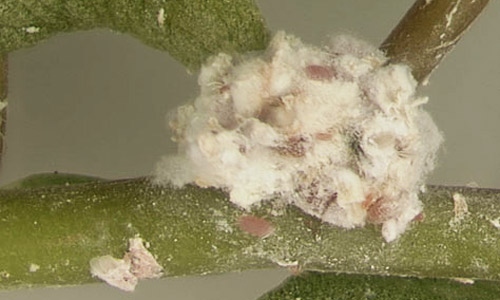
Field specimens of Hypogeococcus pungens are sometimes confused with the pink hibiscus mealybug, Maconellicoccus hirsutus (Green), but the potential hosts of Hypogeococcus pungens are more restrictive. The only other species of Hypogeococcus that occurs in Florida is the native Hypogeococcus margaretae Miller. The only known host for Hypogeococcus margaretae is the hatpin plant, Eriocaulon decangulare, and it has only been reported from St. Lucie and Indian River Counties in Florida.
Synonymy (Back to Top)
A related species, Hypogeococcus festerianus is a valid species, but Hypogeococcus pungens has been misidentified as Hypogeococcus festerianus in the following publications: Hamon (1984), McFadyen and Tomley (1981), Suss and Trematerra (1986), and Williams (1973).
Details of these misidentifications are available on ScaleNet with a Hypogeococcus pungens valid name query.
Distribution (Back to Top)
This mealybug has been reported from Australia, South America, the Caribbean, Europe, and North America. The Australian populations are the result of introduction for the biological control of cacti. Reports of Hypogeococcus pungens in the U.S. include Florida (1984) and Hawaii (2005).
Identification Characteristics (Back to Top)
Adult females are approximately 3 mm long (0.12 inches), produce a reddish body fluid when pierced, and lack both lateral filaments and an ovisac. Hypogeococcus pungens produce large amounts of wax and often form feeding clusters at nodal regions of host plants. The body shape is oval to round, and more round than other pinkish-colored mealybugs (Hodges et al. 2008).
In Florida, heavy infestations of pink-colored mealybugs on Portulaca and Alternathera species are frequently identified as Hypogeococcus pungens. This species is rarely found on cacti in Florida.
Figure 2. Shown infesting cacti is Hypogeococcus spinosus Ferris, which is not established in Florida. This species is related to Hypogeococcus pungens Granara de Willink. Photograph by Lyle J. Buss, University of Florida.
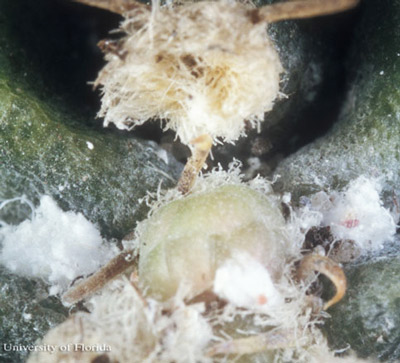
Immature and adult specimens may not be visible until the cottony wax in removed. Clusters of Hypogeococcus pungens tend to occur at nodal regions of leaves and stems.
Figure 3. Late and early instar nymphs of the mealybug Hypogeococcus pungens Granara de Willink. Photograph by Lyle J. Buss, University of Florida.
Figure 4. Adult male (dorsal view) and nymphs of the mealybug Hypogeococcus pungens Granara de Willink. Photograph by Lyle J. Buss, University of Florida.
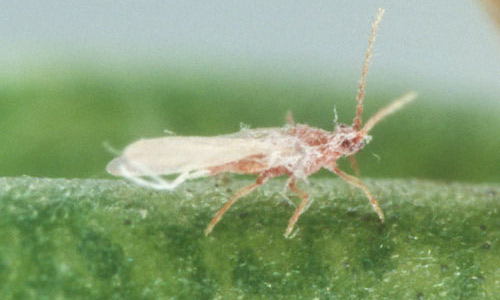
Figure 5. Lateral view of an adult male of the mealybug Hypogeococcus pungens Granara de Willink. Photograph by Lyle J. Buss, University of Florida.
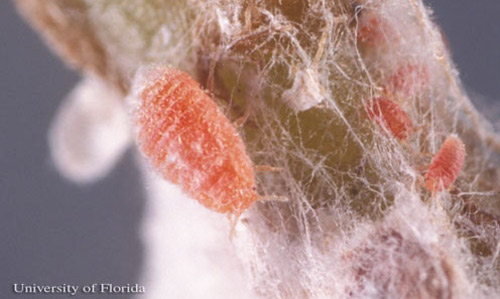
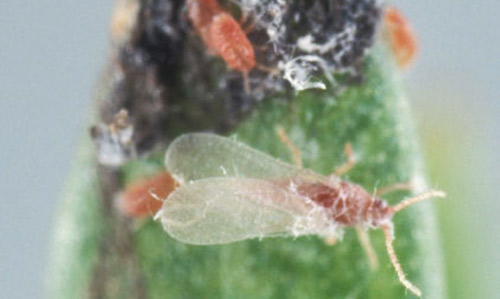
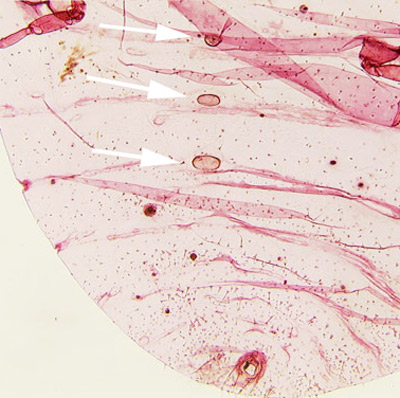
Prior to confirming a diagnosis, scale and mealybug insects (Hemiptera: Coccoidea) generally must be slide-mounted. One of the unique morphological characteristics about Hypogeococcus pungens is the presence of three circuli (Miller et al. 2014, Williams and Willink 1992). The circulus, a structure on the ventral surface of mealybugs, is thought to serve an adhesive function for the insect. Hypogeococcus festerianus, the species originally confused with Hypogeococcus pungens, has only one circulus. Also, the pink hibiscus mealybug and Hypogeococcus margaretae have only one circulus.
Figure 6. Slide mounted specimen of Hypogeococcus pungens Granara de Willink. Arrows pointing to three circuli. Photograph by Greg Hodges, Florida Department of Agriculture and Consumer Services, Division of Plant Industry.
More detailed taxonomic diagnosis information ia available the Scale Insects: Identification tools, images, and diagnostic information for species of quarantine significance provided by the USDA-ARS Systematic Entomology Laboratory.
Life Cycle (Back to Top)
Very little biological or life history information is available specifically for this species. The primary available biological work is Suss and Trematerra (1986). Populations of Hypogeococcus pungens were found both on roots and host leaves or stems. Miller et al. (2014) also report that Hypogeococcus pungens has been intercepted on the roots of Cactaceae.
Hosts (Back to Top)
In comparison to other mealybug species, the host range for Hypogeococcus pungens is fairly limited.
- Amaranthaceae - Achyranthes aspera (Devil's horsewhip), Gomphrena globosa (globe Amaranth)
- Cactaceae - several species with reported genera including Cereus, Eriocerus, Harrisia, Hickenia, Parodia
- Polygonaceae - Alternanthera pungens (khaki weed), A. bettzickiana (joyweed)
- Portulaceae - Portulaca oleracea (purslane, verdolaga, pigweed, little hogweed, or pusley), P. quadrifida (chickenweed)
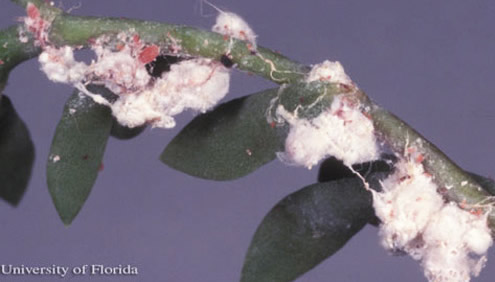
Figure 7. Infestation of the mealybug, Hypogeococcus pungens Granara de Willink. Photograph by Lyle J. Buss, University of Florida.
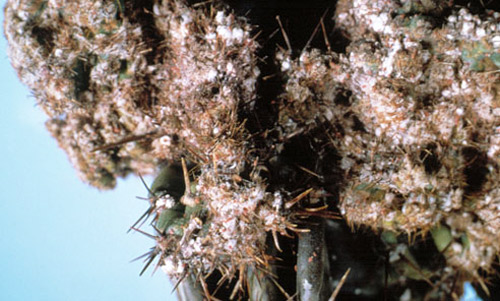
Figure 8. Infestation of the mealybug, Hypogeococcus pungens Granara de Willink. Photograph by Florida Department of Agriculture and Consumer Services, Division of Plant Industry.
Economic Importance (Back to Top)
Hypogeococcus pungens has a very limited host range and appears to be of little economic significance as a pest. Significant pest populations of Hypogeococcus pungens rarely occur in Florida. Although Hypogeococcus pungens was reported occurring on Cactaceae in Italy, subsequent surveys have reported reduced populations (Longo 2009). Exceptions to the general non-pest status of Hypogeococcus pungens could occur in areas with rare or endemic Cactaceae hosts, particularly those that reproduce primarily by seeds instead of budding.
Due to its fairly limited host range, Hypogeococcus pungens was successfully introduced as a biological control agent for the cacti species Eriocereus bonplandii, Eriocereus martini, Eriocereus tortuosus, and Acanthocereus pentago in Australia (McFadyen and Tomley 1981). This species has also been introduced into South Africa for the control of Eriocereus martini (Moran and Zimmermann 1991). Hypogeococcus pungens may be a more effective biological control agent for cacti species that are primarily dependent upon seeds for reproduction. Moran and Zimmerman (1991) noted that the inhibition of flowering and fruiting by Eriocereus martini due to Hypogeococcus pungens limited spread of the pest weed. Although Hypogeococcus pungens was a successfully biological control agent for pest weeds in Australia and South Africa, limited natural dispersal abilities of Hypogeococcus pungens require constant reintroduction of the mealybug as new infestations of the cacti weed occur.
Management (Back to Top)
For high populations of Hypogeococcus pungens, it is often important to confirm the identification of your species prior to implementing a management strategy. This species may be confused with other similar mealybugs, and it is particularly important to report and submit unusual damage in terms of pest frequency or host range to your local diagnostic lab.
The following identification resources are available for Florida residents:
- your local Cooperative Extension Service office
- University of Florida, IFAS Extension Insect Identification Laboratory
- University of Florida, IFAS Mealybug Website
- University of Florida Distance Diagnostic and Identification System
For many mealybug species, natural enemies will often effectively manage populations. The mealybug destroyer, Cryptolaemus montrouzieri, is commonly found in association with many mealybug species as a generalist predator. Moran and Zimmermann (1991) report the presence of a ladybird beetle, Exochomus sp. (Coleoptera: Coccinellidae) feeding on Hypogeococcus pungens, but detailed observations on the impact of this species on populations is not provided.
Natural enemy populations will be negatively impacted by any pesticide applications applied to the host for control of Hypogeococcus pungens or other species. Mealybug populations may also be controlled by horticultural oil applications, but natural enemy populations may be adversely impacted by this as well.
Acknowledgements (Back to Top)
The authors acknowledge Renato Inserra, FDACS-DPI, for translation of the Suss and Trematerra (1986) manuscript and for communications with Santi Longo, University of Cantania in Sicily, regarding status of Hypogeococcus pungens in Italy.
Selected References (Back to Top)
- Granara de Willink MC. 1981. Nueva especies de Hypogeococcus Rau de Tucumán, República Argentina (Homoptera Pseudococcidae). (In Spanish; Summary In English). Neotrópica 27: 61-65.
- Hamon AB. 1984. A cactus mealybug, Hypogeococcus festerianus (Lizer y Trelles), in Florida. Florida Department of Agriculture and Consumer Services, Division of Plant Industry. Entomology Circular 263.
- Hodges A, Hodges G, Buss L, Osborne L. (2008). Mealybugs and mealybug look-alikes of the Southeastern United States. North Central IPM Center. http://firstdetectortt.ifas.ufl.edu/static/pdf/mealybugs.pdf (24 January 2019)
- Longo S. (2009). Personal Communication. University of Cantania in Sicily. Professor of Entomology Department.
- McFadyen RE, Tomley AJ. 1981. The successful biological control of Harrisia cactus (Eriocereus martinii) in Queensland. pp 139-143. In Wilson BJ and Swarbrick JT. (Editors), Proceedings of the 6th Australian Weed Conference. Queensland Weed Society for the Council of Australian Weed Science Societies, Australia. 235 pp. (2 vols.)
- Miller D, Rung A, Parikh G, Venable G, Redford AJ, Evans GA, Gill RJ. 2014. Scale Insects, Edition 2, USDA APHIS Identification Technology Program (ITP). Fort Collins, CO. https://idtools.org/id/scales/ (24 January 2019)
- Moran VC, Zimmermann HG. 1991. Biological control of cactus weeds of minor importance in South Africa. Agriculture, Ecosystems, and Environment 37: 37-55.
- Süss L, Trematerra P. 1986. Hypogeococcus festerianus (Lizer y Trelles), nocivo alle Cactacee ornamentali in Leguria. (In Italian). Informatore Fitopatologia 10: 43-46.
- Unknown. (2006). Annual Report FY 2006. Hawaii Department of Agriculture. http://hawaii.gov/hdoa/meetings_reports/legislative-reports/2007LegReports/Appendix%204%20-%20PI%20Annual%20Rpt..pdf (19 June 2009).
- Williams DJ. 1973. Two cactus-feeding mealybugs from Argentina (Homoptera, Coccoidea, Pseudococcidae). Bulletin of Entomological Research 62: 565-570.
- Williams DJ, Granara de Willink MC. 1992. Mealybugs of Central and South America. CAB International, London, England. 635 pp.