common name: golden silk spider
scientific name: Trichonephila clavipes (Linnaeus) (Arachnida: Araneae: Tetragnathidae)
Introduction - Abbreviated Synonymy - Distribution - Identification - Life History, Habits, and Habitat - Selected References
Introduction (Back to Top)
In Florida and other southeastern states, the golden silk spider, Trichonephila clavipes (Linnaeus), a large orange and brown spider with the feathery tufts on its legs is well know to most native southerners. It is particularly despised by hikers and hunters, as during late summer and fall the large golden webs of this species make a sticky trap for the unwary. However, as is typical with most spiders, there is little real danger from an encounter with the golden silk spider. The spider will bite only if held or pinched, and the bite itself will produce only localized pain with a slight redness, which quickly goes away. On the whole, the bite is much less severe than a bee sting. Typically, the webs are made in open woods or edges of dense forest, usually attached to trees and low shrubs, although they may be in the tops of trees or between the wires of utility lines (Krakauer 1972). Prey consists of a wide variety of small to medium-sized flying insects, including flies, bees, wasps, and small moths and butterflies (Robinson and Mirick 1971). We have also seen them feeding on small beetles and dragonflies. These spiders are not usually found in row crops, due to requirements of web support, but they were one of the two most common orb-weavers in citrus groves (Muma 1975) and have been recorded from pecan (Whitcomb unpublished). Small, immature instars occasionally make webs between rows in soybean fields (Whitcomb and Edwards unpublished).
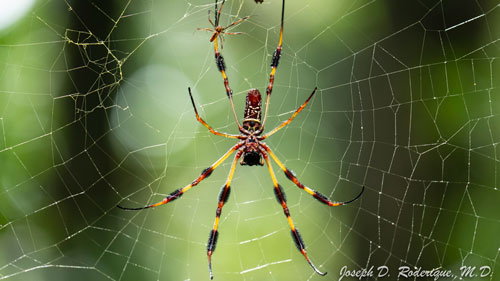
Figure 1. Adult female golden silk spider, Trichonephila clavipes (Linnaeus), with a smaller male at the top center of the photo. Photograph by Joseph D. Roderique.
Abbreviated Synonymy (Back to Top)
Aranea clavipes Linnaeus 1767: 1034.
Aranea spinimobilis Linnaeus 1767: 1034.
Aranea cornuta: Pallas 1772: 44.
- (= spinimobilis)
Aranea fasciculata: DeGeer 1778: 316.
- (= clavipes)
Aranea longimana Fabricius 1781: 536.
Epeira clavipes: Walckenaer 1805: 54.
Nephila clavipes: MacLeay 1834: 12.
Nephila fasciculata: Koch, C.L. 1839a: 30.
Nephila plumipes Koch, C.L. 1839b: 138.
Epeira vespucea Walckenaer 1842: 98.
Epeira janeira Walckenaer 1842: 100.
Nephila sylphurea Taczanowski 1873: 148.
Nephila wilderi McCook 1894: 87.
Nephila wistariana McCook 1894: 252.
Nephila concolor McCook 1894: 256.
Trichonephila clavipes Dahl 1911: 271.
Discussion: The genus Aranea Linnaeus and its synonym Epeira Walckenaer each consisted of a large conglomerate of species, related and unrelated, some of which are still in the process of revision. One of the distinct groups of species that was recognized and named relatively early in the history of araneoid nomenclature was Nephila (Leach 1815). MacLeay (1834) apparently was the first to recognize that Aranea clavipes Linnaeus belonged in the genus Nephila.
Distribution (Back to Top)
Trichonephila clavipes is the only species of the genus occurring in the Western Hemisphere. It occurs throughout Florida, the West Indies, as far north as North Carolina, across the Gulf States, through Central America, and into South America as far south as Argentina. Other even larger relatives occur in the South Pacific, southeast Asia, and Madagascar.
Identification (Back to Top)
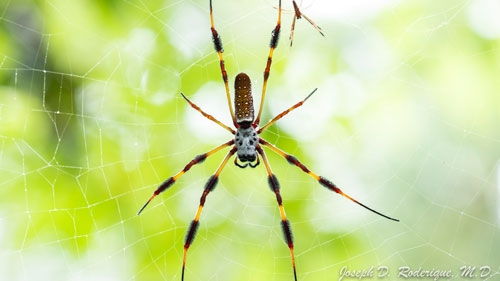
Trichonephila clavipes females are among the largest non-tarantula-like spiders in North America and are perhaps the largest orb-weavers in this country, rivaled in size only by Argiope aurantia (Fabricius) and the largest Araneus species, including Araneus bicentenarius (McCook). Females range from 24 mm to 40 mm in length. The female color pattern, consisting of silvery carapace, yellow spots on a dull orange to tan cylindrical body, brown and orange banded legs, plus the hair brushes (gaiters) on the tibial segment of legs, I, II, and IV, make this spider one of the most easily recognized. The males, on the other hand, are rather inconspicuous dark brown, slender spiders averaging 6 mm in length which would often go unnoticed if not for the fact that they are often found in the webs of females.
Figure 2. Male and female golden silk spider, Trichonephila clavipes (Linnaeus). Smaller male is in the background at the top. Photograph by Joseph D. Roderique.
Life History, Habits, and Habitat (Back to Top)
Trichonephila clavipes in temperate North America has one generation per year under field conditions. Adult males are present from July to September, with most females maturing in August. Mature females are found late into the fall, when they make at least two large eggsacs 2.5 to 3 cm in diameter consisting of several hundred eggs surrounded by a basket of curly yellow silk. Populations in the tropical parts of the range probably produce more eggsacs, as the related Trichonephila maculata (Fabricius) averaged nearly nine eggsacs per female in New Guinea (Robinson and Robinson 1973a). The life history of Trichonephila clavipes has not been studied through all the instars, but it is probably quite similar to Trichonephila maculata (Robinson and Robinson 1976), with one or two fewer instars.
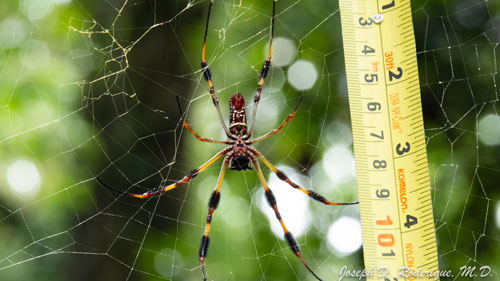
The finely meshed, large web of Trichonephila clavipes (often 1 to 2 meters in diameter) is placed to best exploit insect flight paths (i.e., above the herbaceous stratum). In tropical America, webs are found most frequently at edges of forest clearings, alongside forest trails, and across forest watercourses (Robinson and Mirick 1971). The hub of the web where the spider waits is located near the top of the web, making an asymmetrical orb. Kaston (1972) gives an illustration of a portion of a web in detail. The web is a semipermanent structure, i.e., it is not destroyed and created periodically as is the case with many members of the similar family Araneidae. Large portions of the web may be repaired leaving the remainder undisturbed (Peters 1955). Occasionally stabilimenta (bands of zigzag silk) are incorporated into complete webs of immatures, and more frequently are found on skeleton webs (webs lacking viscid spiral) made by immatures and used as molting platforms (Robinson and Robinson 1973b).
Figure 3. Female golden silk spider, Trichonephila clavipes (Linnaeus), on web. Photograph by Joseph D. Roderique.
Prey-capture behavior by Trichonephila species is considered primitive compared to species of Argiope and Eriophora. The large species in these latter genera make webs nearly as large as those of Trichonephila, yet the mesh of these webs are coarse when compared to those of Trichonephila. Trichonephila clavipes capture smaller prey on the average than do, for example, Argiope argentata (Fabricius) or Eriophora fuliginea (C.L. Koch) webs of similar size. However, due to their use of immobilization wrapping as a primary attack weapon (Robinson 1969, Robinson and Olazarri 1971, Robinson et al. 1969), Argiope and Eriophora species are able to capture larger prey on the average than do Trichonephila species which directly employ biting to subdue the prey. Differences in web mesh size and attack behaviors between the two types of orb-weavers can be viewed as an evolutionary advancement by these other large orb-weavers to reduce competition for prey with Trichonephila.
Webs of Trichonephila species, as well as of other large orb-weavers, are liable to kleptoparasitism by small (3 to 4 mm) silvery spiders of the genus Argyrodes Simon (family Theridiidae). Robinson and Robinson (1976) recorded as many as 30 of these kleptoparasites in a single web of Trichonephila maculata, and we have seen over 40 Argyrodes in an abandoned Trichonephila clavipes web. This latter observation was noteworthy, since Robinson and Robinson (1976) demonstrated that Trichonephila species could reduce the kleptoparasitic load by periodically moving their webs even if the web site was productive of prey. One aspect of prey capture by Trichonephila species, that of always bringing the prey back to the hub rather than leaving wrapped prey in situ, has been hypothesized to be a preventative action to reduce the amount of food stolen by Argyrodes, since detection of the theft action of the kleptoparasites would be difficult on such a large web (Robinson and Robinson 1973a).
Another problem faced by golden silk spiders in tropical and subtropical climates is overheating. Special behaviors and body features have evolved in Trichonephila to protect against the problem. The silvery carapace reflects sunlight, while the long, cylindrical body may be pointed directly at the sun, thus reducing the area of exposed body surface. Force evaporative cooling may be employed by manipulating a drop of fluid with the chelicerae. Cooling responses generally occur above 35°C (Krakauer 1972). The web does not have to be perpendicular to the sun in order for the spider to employ orientation; in fact, webs are generally placed so as to capture the most insects regardless of the sun's position, and the spider's orientation movements can be quite complex (Robinson and Robinson 1974).
In the South Pacific, females of Trichonephila maculata are induced to build webs on bamboo frames, which are then used as fish nets. The natives also relish the gravid females as a protein supplement, eating them either raw or roasted. Different reports say that the flavor is somewhat like mixed raw potato and lettuce mixed, or nutty flavored like peanut butter with a sticky consistency (Robinson and Robinson 1976).
Selected References (Back to Top)
- Dahl F. 1911. Die Verbreitung der Spinnen spricht gegen eine fruhere Landverbindung der Sudspitzen unserer Kontinente. Zoologischer Anzeiger 37: 270-282.
- DeGeer C. 1778. Memoires pour servir à l'histoire des insectes. Stockholm 7: 176-324.
- Fabricius JC. 1781. Species insectorum exhibentes eorum differentias specificas, synonyma auctorum, loca notalia, metamorphos in adiectis observationibus, descriptionibus. Hamburgi and Kilonii 1: 536-547.
- Kaston BJ. 1972. How to Know the Spiders. Wm. C. Brown Co. Publishers, Dubuque, Iowa. 289 p.
- Koch CL. 1839a. Die Arachniden. Nurnberg 5: 1-158.
- Koch CL. 1839b. Die Arachniden. Nurnberg 6: 1-156.
- Krakauer T. 1972. Thermal responses of the orb-weaving spider, Nephila clavipes (Araneae: Argiopidae). American Midland Naturalist 88: 245-250.
- Leach WE. 1815. Zoological miscellany; being descriptions of new and interesting animals. London 2: 1-154.
- Linnaeus C. 1767. Systema Naturae (12th edition) per regna trianaturae, secundum classes, ordines, genera, species, cum characteribus differentiis, synonymis, locis. Editio duodecima, reformata, Holmiae 1: 553-1327.
- MacLeay WS. 1834. A few remarks tending to illustrate the natural history of two annulose genera, namely Uranis of Fabricius and Mygale of Walckenaer. Proceedings of the Zoology Society London 2: 10-12.
- McCook HC. 1894. American spiders and their spinningwork. Philadelphia 3: 1-285.
- Muma MH. 1975. Spiders in Florida citrus groves. Florida Entomologist 58: 83-90.
- Pallas PS. 1772. Spicilegia Zoologica. Continens Quadrupedium, Avium, Amphibiorum, Piscium, Insectorum, Molluscorum Aliorumque Marinorum Fasciculos decem. Berolini 1: 44-50.
- Peters HM. 1955. Contribuciones sobre la etología y ecología comparada de las arañas tejedoros tropicales. Comunicaciones del Instituto Tropical de la Universidad de El Salvador 1-2: 37-56.
- Robinson MH. 1969. Predatory behavior of Argiope argentata (Fabricius). Amererican Zoologist 9: 161-173.
- Robinson MH, Mirick H. 1971. The predatory behavior of the golden-web spider Nephila clavipes (Araneae: Araneidae). Psyche 78: 123-139.
- Robinson MH, Mirick H, Turner O. 1969. The predatory behavior of some araneid spiders and the origin of immobilization wrapping. Psyche 76: 487-501.
- Robinson MH, Olazarri J. 1971. Units of behavior and complex sequences in the predatory behavior of Argiope argentata (Fabricius): (Araneae: Araneidae). Smithsonian Contributions to Zoology 65: 1-36.
- Robinson MH, Robinson B. 1973a. Ecology and behavior of the giant wood spider Nephila maculata (Fabricius) in New Guinea. Smithsonian Contributions to Zoology 149: 1-76.
- Robinson MH, Robinson B. 1973b. The stabilimenta of Nephila clavipes and the origins of stabilimentum-building in araneids. Psyche 80: 277-288.
- Robinson MH, Robinson B. 1974. The thermoregulatory postures of the golden-web spider, Nephila clavipes, at low latitudes. American Midland Naturalist 92: 386-396.
- Robinson MH, Robinson B. 1976. The ecology and behavior of Nephila maculata: A supplement. Smithsonian Contributions to Zoology 218: 1-22.
- Walckenaer CA. 1842. Histoire naturelle des Insectes. Aptères 2: 1-549.