common name: lesser cornstalk borer
scientific name: Elasmopalpus lignosellus (Zeller) (Insecta: Lepidoptera: Pyralidae)
Introduction - Distribution - Description and Life Cycle - Host Plants - Weather - Damage - Management - Natural Enemies - Selected References
Introduction (Back to Top)
The lesser cornstalk borer, Elasmopalpus lignosellus (Zeller), was described by Zeller in 1848, but it was not considered of economic importance until 1881 (Riley 1882). It is a pest of several economically important crops.
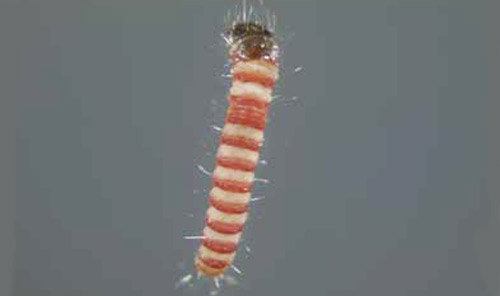
Figure 1. First instar larva of the lesser cornstalk borer, Elasmopalpus lignosellus (Zeller). Photograph by Hardev Sandhu, University of Florida.
Distribution (Back to Top)
The lesser cornstalk borer occurs widely in the western hemisphere and is known from much of the southern United States. Despite its wide distribution, damage is limited principally to crops in sandy soil (Metcalf et al. 1962), so it tends to cause injury in the coastal plain of the southeastern states from South Carolina to Texas. While more often observed in the southeastern United States, this pest species is sporadic in nature and distributed from Maine to southern California.
It was first discovered outside the continental U.S. in July 1986 infesting sugarcane in Kauai (Hawaii) (Chang and Ota 1987). This species is also found in Mexico, Central America, and South America (Luginbill and Ainslie 1917).
Description and Life Cycle (Back to Top)
There are three to four generations annually in the southeast, but in the southwest there are only three generations annually. Activity extends from June to November, with the generations overlapping considerably and little evidence of breaks between generations. Overwintering apparently occurs in the larval and pupal stage, and diapause is not present. A complete life cycle usually requires 30 to 60 days.
Eggs: The eggs are oval, measuring about 0.6 mm in length and 0.4 mm in width. When first deposited, they are greenish, soon turning pinkish, and eventually reddish. The female deposits nearly all her eggs below the soil surface adjacent to plants. A few, however, are placed on the surface or on leaves and stems. Duration of the egg stage is two to three days. A single female can oviposit about 200 eggs (Capinera 2001), with a report of up to 420 eggs (Biddle et al. 1992). Female moths oviposit eggs in late summer and fall in Kentucky (Bessin 2004), while in Florida, we observed heavy oviposition in spring and early summer.
Larvae: Larvae are strong and active when disturbed and wiggle violently so that in some countries it is called the jumping borer (Schaaf 1974). Larvae live in the soil, constructing tunnels from soil and excrement tightly woven together with silk. They leave the tunnel to feed in the basal stalk area or just beneath the soil surface, returning and constructing new tunnels as they mature. Thus, tunnels often radiate out from the stem of the food source, just below the soil surface.
Normally there are six instars, but the number of instars can range from five to nine depending on environmental conditions (Biddle et al. 1992). During the early instars, larvae are yellowish green, with reddish pigmentation dorsally, tending to form transverse bands. As the larvae mature, whitish longitudinal stripes develop, so that by the fifth instar they are pronounced.
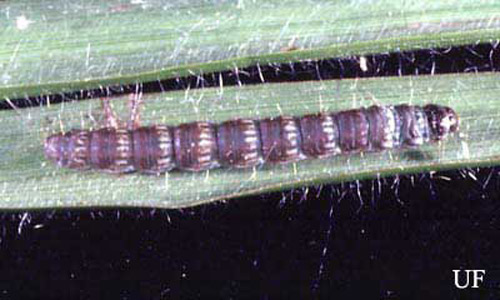
The mature larvae are bluish green, but tend toward reddish brown with fairly distinct yellowish white stripes dorsally. Head capsules are dark in color, and measure about 0.23, 0.30, 0.44, 0.63, 0.89, and 1.2 mm in width, respectively, for instars one through six. Larval lengths are about 1.7, 2.7, 5.7, 6.9, 8.8, and 16.2 mm, respectively. Mean development time is estimated at 4.2, 2.9, 1.4, 3.1, 2.9, and 8.8 days for instars one through six, respectively. Total larval development time varies widely, but normally averages about 20 days.
Figure 2. Mature larva of the lesser cornstalk borer, Elasmopalpus lignosellus (Zeller). Photograph by John L. Capinera, University of Florida.
Pupae: At larval maturity, caterpillars construct pupal cells of sand and silk at the end of the tunnels. Cocoons measure about 16 mm in length and 6 mm in width. The pupae are yellowish initially turning brown and then almost black just before adults emerge. Pupae are about 8 mm long and 2 mm wide. The tip of the abdomen is marked by a row of six hooked spines. Pupal development time averages about nine to 10 days, with a range of seven to13 days.
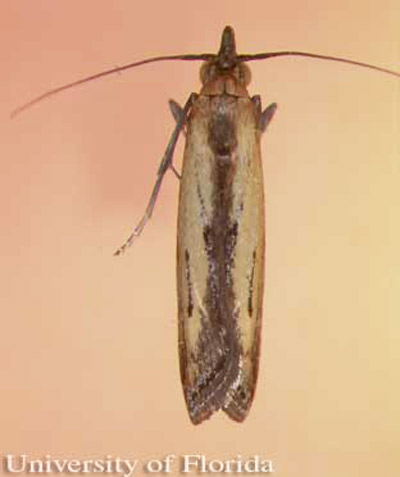
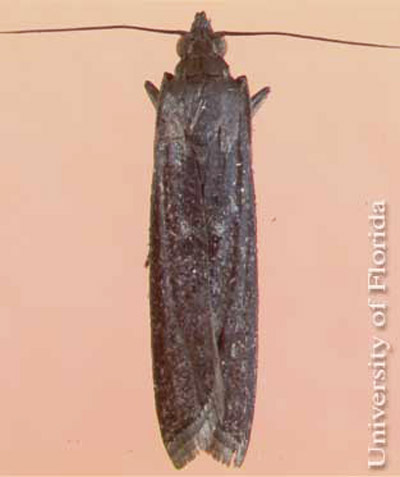
Adults: Moths are fairly small, measuring 17 to 22 mm in wingspan. Sexual dimorphism is pronounced. Variability in color of wings and wing patterns were reported both in male and female moths, depending on climatic and regional conditions (Biddle et al. 1992, Chapin 1999). In general, the forewing of the male moth is yellowish centrally, bordered by a broad dark band bearing purplish scales. In females, however, the entire forewing is dark, sometimes almost black, but also bearing reddish or purplish scales. At rest, the female moth is often charcoal-colored (Biddle et al.1992) with wings held straight back along the body, while the male moth is tan-colored with charcoal wing strips (Chapin 1999). The thorax is light in males, but dark in females. The hind wings of both sexes are transparent with a silvery tint.
Figure 3. Adult male lesser cornstalk borer, Elasmopalpus lignosellus (Zeller). Photograph by Hardev Sandhu, University of Florida.
Figure 4. Adult female lesser cornstalk borer, Elasmopalpus lignosellus (Zeller). Photograph by Hardev Sandhu, University of Florida.
Adults are most active at night when the temperature exceeds 27°C, relative humidity is high, and there is little air movement. Such conditions are optimal for mating and oviposition. Adult longevity under field conditions is estimated at about 10 days.
Weather (Back to Top)
Lesser cornstalk borers seem to be adapted for hot, xeric conditions, and therefore tend to be more abundant and damaging following unusually warm, dry weather. On peanuts, this species mostly occurs in noneconomic densities, but sporadic outbreaks are associated with hot and dry climatic conditions (Smith and Barfield 1982). Weather factors, mainly temperature, contribute to the buildup of lesser cornstalk borer populations because the eggs are oviposited at a faster rate in hot weather (Mack and Backman 1984).
Mack et al. (1993) used data from Alabama and Georgia to develop a predictive equation that forecasts the potential for crop injury and the need to monitor crops. It is based on the concept of borer-days. Borer-days is calculated as the sum of days during the growing season in which the temperature equals or exceeds 35°C and the precipitation is less than 2.5 mm, less the number of days in which the temperature is less than 35°C and the precipitation equals or exceeds 2.5 mm. Thus, it is the sum of the number of hot, dry days less the number cooler, wetter days. If the number of borer-days equals or exceeds 10, damage is likely. If borer days equals 5 to 9, then damage is possible and fields should be scouted. The relationship between borer-days and larval abundance is nonlinear, and small increases in borer-days beyond 10 results in large increases in larval abundance.
Host Plants (Back to Top)
Lesser cornstalk borer is a polyphagous pest that often attacks several crops throughout the southeastern United States. Vegetables and field crops injured by lesser cornstalk borer are shown in Table 1. Legume and grass crops are most often damaged. In Georgia, Leuck (1966) reported that due to the semi-subterranean nature of lesser cornstalk borer, it fed on and damaged seedlings and mature soybean plants above and below the soil surface. Crops that are grown in late spring and early fall in northern Florida (soybeans, peanuts, and grain sorghum) are candidates for damage by lesser cornstalk borer, due to their favorable host status and exposure to high populations of lesser cornstalk borer (Tippins 1982).
Lesser cornstalk borer has a number of weed hosts, such as: nutsedges (Cyperus rotundus), watergrass (Hydrochloa caroliniensis), Johnsongrass (Sorghum halepense), crabgrass (Digitaria sanguinalis), wild oats (Avena fatua), Bermudagrass (Cynodon dactylon), wiregrass (Aristida stricta), and goosegrass (Eleusine indica) (Isely and Miner 1994, Gardner and All 1982).
Common name
|
Scientific name
|
Bean
|
Phaseolus vulgaris
|
Beet
|
Beta vulgaris
|
Cabbage
|
Brassica oleracea var. capitata
|
Cantaloupe
|
Cucumis melo
|
Chufa
|
Cyperus esculentus
|
Corn
|
Zea mays
|
Cowpea
|
Vigna unguiculata
|
Lima bean
|
Phaseolus lunatus
|
Oat
|
Avena sativa
|
Pea
|
Pisum sativum
|
Peanut
|
Arachis hypogaea
|
Pepper
|
Capsicum annuum
|
Rice
|
Oryza sativa
|
|
Secale cereale
|
Sorghum
|
Sorghum bicolor
|
Soybean
|
Glycine max
|
Sudangrass
|
Sorghum sudanense
|
Sugarcane
|
Saccharum officinarum
|
Sweetpotato
|
Ipomoea batatas
|
Tomato
|
Lycopersicon esculentum
|
Turnip
|
Brassica rapa
|
Wheat
|
Triticum aestivum
|
Damage (Back to Top)
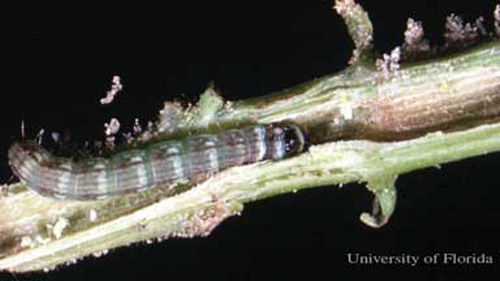
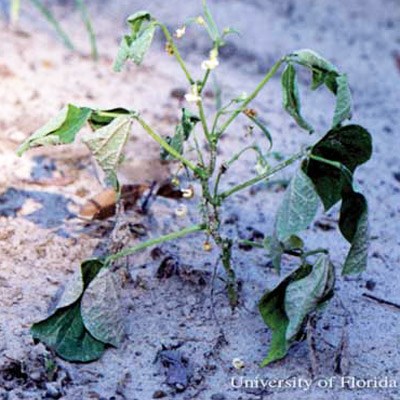
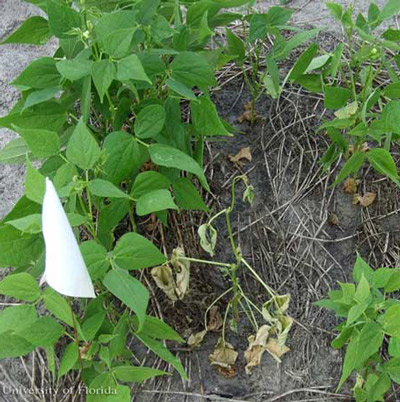
The larval stage causes damage when it feeds upon, and tunnels within, the stems of plants. Normally the tunneling is restricted to the basal region of stalks, including the belowground portion, and girdling may occur. Wilting is one of the first signs of attack in affected plants, but buds may wither, and stunting and plant deformities are common. Plant death is not uncommon, and infested areas of fields often have a very thin stand. Sweet corn plants that do not die after the damage of lesser cornstalk borer produced several bushy and stunted suckers with no marketable ears (Nuessly and Webb 2006). Bessin (2004) reported that the growing point of the plant was killed, leading to dead hearts symptoms that are similar to the attack of wireworms. Dead hearts symptoms are caused by the larva boring into the stalk at the soil level and tunneling upward.
Figure 5. Lesser cornstalk borer, Elasmopalpus lignosellus (Zeller), larva showing stem tunneling by larva. Photograph by James L. Castner, University of Florida.
Figure 6. Lesser cornstalk borer, Elasmopalpus lignosellus (Zeller), damage to soybean. Note wilting due to stalk feeding by larvae. Photograph by James L. Castner, University of Florida.
Figure 7. Lesser cornstalk borer, Elasmopalpus lignosellus (Zeller), damage. Note wilting due to stalk feeding by larvae. Photograph by Harsimran Gill, University of Florida.
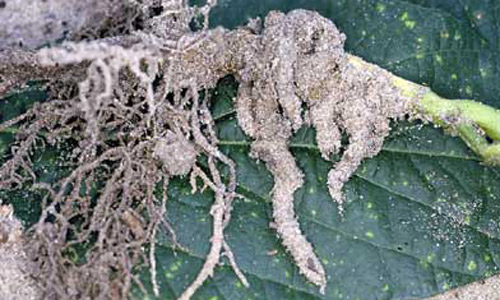
Silken webbing forming a small tube in the soil at the base of the stalk is evidence of the attack of lesser cornstalk borer. The larvae bore into the stalk base near the soil surface causing damage to vascular tissues that result in these "dead hearts" symptoms and also allow pathogens to enter into the plant (Smith and Ota 2002).
Figure 8. Soil tubes formed by the lesser cornstalk borer, Elasmopalpus lignosellus (Zeller). Photograph by University of Florida.
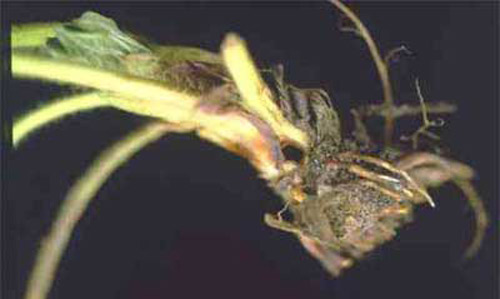
Figure 9. Entrance to the gallery of a lesser corn stalk borer, Elasmopalpus lignosellus (Zeller). This entrance is usually seen in conjunction with a sandy, silken tub from the entrance to the soil below. Photograph by James F. Price, University of Florida.
Management (Back to Top)
Sampling: The egg stage is difficult to sample because eggs are small and resemble sand grains. However, eggs can be separated by flotation. Larval populations are aggregated, and can be separated from soil by sieving or flotation (Mack et al. 1991). To scout for lesser cornstalk borer, uproot small plants in 10 locations in a field. If live larvae and pupae are found in 10% of plants, then treatment is recommended (Chapin 1999).
Adults are attracted to light traps, but are difficult to monitor with this technique because lesser cornstalk borer moths are difficult to distinguish from many other species. This is especially true of the females, which are less distinctive than the males. Pheromone traps have been used successfully to monitor adult populations, and adults can be flushed from fields by beating the vegetation. Adult pheromone trap catches and flush counts are correlated (Funderburk et al. 1985). Adult and larval counts are often highly correlated, indicating that flush counts can be used to predict the abundance of larvae in subsequent weeks.
Insecticides: Insecticides applied for suppression of lesser cornstalk borer are usually applied in a granular formulation in the seed furrow or in a band over the seed bed, using restricted pesticides according to label recommendations. Liquid formulations can also be applied, but it is important that they be directed to the root zone.
Cultural practices: Modified planting practices have long been used to minimize crop loss. Populations tend to increase over the course of a season, so some damage can be avoided by early planting. Tillage and destruction of weeds are recommended prior to planting because this helps to destroy larvae that may be present in the soil and might damage seedlings, the stage most susceptible to destruction. However, crop culture that uses conservation tillage (i.e., retention of crop residue at the soil surface) experiences less injury from lesser cornstalk borer feeding because the larvae feed freely on crop residue and other organic matter, sparing the young crop plants (All et al. 1979).
Smith and Ota (2002) observed that the lesser cornstalk borer damage on sugarcane in Hawaii can be avoided by following agronomic practices that enhance the plant vigor to tolerate damage caused by lesser cornstalk borer. Frequent irrigation is also an important agronomic practice for the management of lesser cornstalk borer because moist soils discourage female moths from laying eggs and also suppress larval populations in the soil. Our recent observations suggest that mulching may reduce incidence of lesser cornstalk borer attack.
Natural Enemies (Back to Top)
While several natural enemies of lesser cornstalk borer are known, they are not thought to be major determinants of population trends. Smith and Johnson (1989) constructed life tables for populations in Texas, and identified survival of large lesser cornstalk borer larvae as the key element in generation survival, but the causative factor remains unidentified. The predominant parasitoids are Orgilus elasmopalpi Muesebeck and Chelonus elasmopalpi McComb (both Hymenoptera: Braconidae), Pristomerus spinator (Fabricius) (Hymenoptera: Ichneumonidae), and Stomatomyia floridensis Townsend (Diptera: Tachinidae) through most of the range of lesser cornstalk borer (Funderburk et al. 1984). Other parasitoids sometimes present include Bracon gelechiae Ashmead (Hymenoptera: Braconidae), Geron aridus Painter (Diptera: Bombyliidae), and Invreia spp. (Hymenoptera: Chalcididae). Parasitoids rarely cause more than 10% mortality.
Among the predators thought to be important mortality factors are a ground beetle, Plilophuga viridicolis LeConte (Coleoptera: Carabidae); big-eyed bugs, Geocoris spp. (Hemiptera: Lygaeidae); and larval stiletto flies (Diptera: Therevidae).
Pathogens are commonly present in lesser cornstalk borer populations. The most important pathogen appears to be a granulosis virus, but a Beauveria sp. fungus, microsporidia, and mermithid nematodes also have been found (Funderburk et al. 1984). Natural enemies generally did not greatly affect population levels of lesser cornstalk borer, due to its subterranean habits, silken webbing, and sporadic nature.
Selected References (Back to Top)
- All JN, Gallaher RN, Jellum MD. 1979. Influence of planting date, preplanting weed control, irrigation, and conservation tillage practices on efficacy of planting time insecticide applications for control of lesser cornstalk borer in field corn. Journal of Economic Entomology 72: 265-268.
- Bessin R. 2004. The common stalk borer in corn. University of Kentucky, Entomology. University of Kentucky, Lexington, KY. http://www.ca.uky.edu/entomology/entfacts/ef100.asp (5 September 2008)
- Biddle AJ, Hutchins SH, Wightman JA. 1992. Pests living below ground, Elasmopalpus lignosellus: Lesser cornstalk borer, pp. 202-203. In McKinley RG. [editor] Vegetable Crop Pests. CRC press, Boca Raton, FL.
- Capinera JL. 2001. Handbook of Vegetable Pests. Academic Press, San Diego. 729 pp.
- Chang V, Ota AK. 1987. The lesser cornstalk borer: a new important pest of young sugarcane, pp. 27-30 In Annual Report, 1986. Experiment station. Hawaiian Sugar Planter's Association, Pahala, HI.
- Chapin JW. (1999). Lesser cornstalk borer on peanut. Entomology insect information Series. http://entweb.clemson.edu/eiis/pdfs/ag21.pdf (20 August 2008).
- Funderburk JE, Boucias DG, Herzog DC, Sprenkel RK, Lynch RE. 1984. Parasitoids and pathogens of larval lesser cornstalk borers (Lepidoptera: Pyralidae) in northern Florida. Environmental Entomology 13: 1319-1323.
- Funderburk JE, Herzog DC, Mack TP, Lynch RE. 1985. Sampling lesser cornstalk borer (Lepidoptera: Pyralidae) adults in several crops with reference to adult dispersion patterns. Environmental Entomology 14: 452-458.
- Gardner WA, All JN. 1982. Chemical control of the lesser cornstalk borer in grain sorghum. Journal of Georgia Entomological Society. 17: 167-171.
- Isely D, Miner FD. 1994. The lesser cornstalk borer, a pest of fall beans. Journal of Kansas Entomological Society. 17: 51-57.
- Leuck DB. 1966. Biology of the lesser cornstalk borer in south Georgia. Journal of Economic Entomology 59: 797-801.
- Luginbill P, Ainslie GG. 1917. The lesser cornstalk borer. U.S. Department of Agriculture Bulletin 539. 27 pp.
- Lynch RE, Klun JA, Leonhardt BA, Schwarz M, Garner JW. 1984. Female sex pheromone of the lesser cornstalk borer, Elasmopalpus lignosellus (Lepidoptera: Pyralidae). Environmental Entomology 13: 121-126.
- Mack TP, Backman CB. 1984. Effects of temperature and adult age on the oviposition rate of Elasmopalpus lignosellus (Zeller), the lesser cornstalk borer. Environmental Entomology. 13: 966-969.
- Mack TP, Davis DP, Backman CB. 1991. Predicting lesser cornstalk borer (Lepidoptera: Pyralidae) larval density from estimates of adult abundance in peanut fields. Journal of Entomological Science 26: 223-230.
- Mack TP, Davis DP, Lynch RE. 1993. Development of a system to time scouting for the lesser cornstalk borer (Lepidoptera: Pyralidae) attacking peanuts in the southeastern United States. Journal of Economic Entomology 86: 164-173.
- Metcalf CL, Flint WP, Metalf RL. 1962. Lesser cornstalk borer, pp. 497-498. In Destructive and useful insects. McGraw-Hill Book Company, San Francisco, CA.
- Nuessly GS, Webb SE. (2007). Insect management for sweet corn. EDIS. http://edis.ifas.ufl.edu/IG158 (7 May 2020).
- Riley CV. 1882. The smaller corn stalk-borer. U. S. Department of Agriculture Report 1881: 142-145.
- Schaaf AC. 1974. Jumping borer, Elasmopalpus lignosellus, pp. 31-34. In Handbook of pests of sugarcane. Tech Bull 1/75. Sugar Industry Research Institute Mandeville, Jamaica.
- Smith JW Jr, Barfield CS. 1982. Management of preharvest insects, pp. 250- 325. In Pattee HE, Young CT (editors), Peanut science and technology. American Peanut Research Education Society, Yoakum, TX.
- Smith Jr JW, Johnson SJ, Sams RL. 1981. Spatial distribution of lesser cornstalk borer eggs in peanuts. Environmental Entomology 10: 192-193.
- Smith Jr JW, Johnson SJ. 1989. Natural mortality of the lesser cornstalk borer (Lepidoptera: Pyralidae) in a peanut agroecosystem. Environmental Entomology 18: 69-77.
- Smith HA, Ota AK. 2002. An overview of the lesser cornstalk borer management program at HARC-HSPA, 1986-2002. Hawaii Agricultural Research Center. http://www.hawaiiag.org/harc/EntR1.htm (7 May 2020).
- Tippins HH. 1982. A Review of Information on the Lesser Cornstalk Borer Elasmopalpus lignosellus (Zeller). Georgia Agricultural Experiment Station Special Publication 17. 65 pp.